New to public comment periods?
February 4, 2017
February 3 2017 – Washington D.C.
In spite of a disappointing ruling by a US Judge on Thursday afternoon, February 2, public opposition remains to an unprecedented plan to ship 23,000 litres (6000 gallons) of intensely radioactive liquid from Chalk River, Ontario, to the Savannah River Site in South Carolina – a distance of over 2000 kilometres. The liquid is an acidic solution of dozens of extremely radiotoxic materials such as cesium-137, strontium-90, and plutonium-239.
The first armed convoy, in a series of 100-150 truckloads over a period of four years, had been put on hold pending the outcome of a legal challenge in US federal court. Plaintiffs had urged the court to either suspend the shipments, or to require a Supplemental Environmental Impact Statement in compliance with US environmental law (NEPA), because such highly radioactive material has never before been transported over public roads in liquid form.
But on February 2 the court ruled against the Plaintiffs, deferring to the Department of Energy’s 2013 and 2015 claims that the transport of this dangerous waste in liquid form poses no more dangers than hauling it in solid form. So now, these unprecedented highly radioactive liquid waste shipments have been judged to have no legal obstacles, even without an EIS. Consequences of a spill and discussion of alternatives will not be available for scrutiny by the public or other agencies as a result of the ruling.
The suit was brought by seven US organizations: Beyond Nuclear, Nuclear Information and Resource Service, Savannah River Site Watch, Citizens for Alternatives to Chemical Contamination, Lone Tree Council, Sierra Club and Environmentalists, Inc. Dozens of other organizations on both sides of the border support the plaintiffs in their opposition. All these groups will continue to challenge the plan to transport such dangerous liquid over public roads and bridges – a feat never before attempted, and one they consider to be entirely unnecessary as there are safer alternatives.
Tom Clements, director of Savannah River Site Watch in South Carolina, said “Citizens here don’t want to be a dumping ground for Canada’s nuclear waste. Last year, Indonesia demonstrated a method called ‘down-blending’, carried out with DOE approval, that eradicates any need for shipping highly radioactive liquid. The same technique can be utilized at Chalk River. Down-blending and solidifying the waste in Canada would be cheaper, faster and safer than moving this dangerous liquid cargo through dozens of communities, then processing and dumping it into aging waste tanks at SRS.”
Gordon Edwards, Ph.D., a mathematician with the Canadian Coalition for Nuclear Responsibility, and Marvin Resnikoff, Ph.D., a physicist with the US-based Nuclear Waste Management Associates, both filed technical declarations in support of the lawsuit.
Dr. Edwards’ declaration based on published data from the Canadian Nuclear Safety Commission and the US Environmental Protection Agency, showed that the toxicity of a few ounces of the Chalk River liquid would ruin an entire city’s water supply. “This liquid is among the most radiotoxic materials on earth,” said Dr. Edwards.
Dr. Resnikoff’s statement pointed out that a severe sideways impact of the transport cask, or a prolonged diesel fire causing boiling of the liquid and over-pressure rupture of the containers, could spill the liquid contents into the environment. “The consequences of such realistic accident scenarios have not been adequately assessed,” said Dr. Resnikoff, adding that the containers have never been tested physically under such realistic conditions. The Judge disallowed the two expert declarations.
Mary Olson, one of the plaintiffs in the law suit, said “Even without any leakage of the contents, people will be exposed to penetrating gamma radiation and damaging neutron radiation just by sitting in traffic beside one of these transport trucks. And because the liquid contains weapons-grade uranium there is an ever-present possibility of a spontaneous chain reaction giving off a powerful blast of life-threatening neutrons in all directions – a so-called “criticality” accident.”
 Graphic: Wikimedia Commons[/caption]
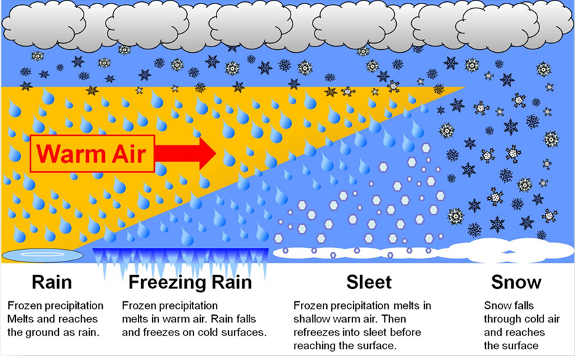
The formation of ice begins with a layer of above-freezing air above a layer of sub-freezing temperatures closer to the surface. Frozen precipitation melts to rain while falling into the warm air layer, and then begins to refreeze in the cold layer below. If the precipitate refreezes while still in the air, it will land on the ground as sleet.
Alternatively, the liquid droplets can continue to fall without freezing, passing through the cold air just above the surface. This thin layer of air then cools the rain to a temperature below freezing (0 °C or 32 °F). However, the drops themselves do not freeze, a phenomenon called supercooling (or forming “supercooled drops“). When the supercooled drops strike ground or anything else below 0 °C freezing (power lines, tree branches for example), a layer of ice accumulates as the cold water drips off, forming a slowly thickening film of ice.
Given this information, simple logic shows how an increased presence of warm air masses can lead to more ice storms. But logic isn’t the only epistemology. What does the empiricism of science have to say about climate change and future ice storms?
Not much, yet. While consensus is clear that the overall climate is warming and will continue to warm, how that will effect the frequency of specific weather conditions such as ice storms remains unclear. It is generally accepted that there will be an increased frequency of storm events overall. Studies are being performed to determine whether or not that means more ice storms for the northeastern US and eastern Canada.
[caption id="attachment_701" align="aligncenter" width="563"]
Graphic: Wikimedia Commons[/caption]
The formation of ice begins with a layer of above-freezing air above a layer of sub-freezing temperatures closer to the surface. Frozen precipitation melts to rain while falling into the warm air layer, and then begins to refreeze in the cold layer below. If the precipitate refreezes while still in the air, it will land on the ground as sleet.
Alternatively, the liquid droplets can continue to fall without freezing, passing through the cold air just above the surface. This thin layer of air then cools the rain to a temperature below freezing (0 °C or 32 °F). However, the drops themselves do not freeze, a phenomenon called supercooling (or forming “supercooled drops“). When the supercooled drops strike ground or anything else below 0 °C freezing (power lines, tree branches for example), a layer of ice accumulates as the cold water drips off, forming a slowly thickening film of ice.
Given this information, simple logic shows how an increased presence of warm air masses can lead to more ice storms. But logic isn’t the only epistemology. What does the empiricism of science have to say about climate change and future ice storms?
Not much, yet. While consensus is clear that the overall climate is warming and will continue to warm, how that will effect the frequency of specific weather conditions such as ice storms remains unclear. It is generally accepted that there will be an increased frequency of storm events overall. Studies are being performed to determine whether or not that means more ice storms for the northeastern US and eastern Canada.
[caption id="attachment_701" align="aligncenter" width="563"]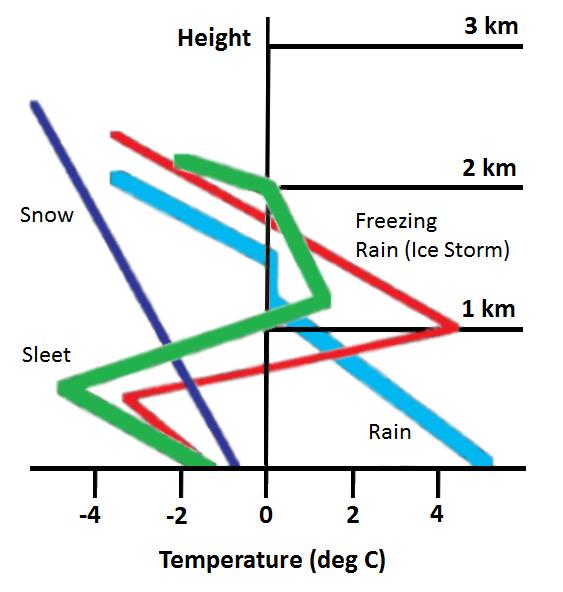 Graphic: Wikimedia Commons[/caption]
The conditions for an ice storm are, as we see above, complex. The unpredictable nature of vertical temperature profiles that lead to ice storms makes it difficult to predict increases in their frequency.
Researchers performed a simple “thought experiment” using vertical temperature profile data to explore how these might change given plausible future temperature regimes. Using an approximation for surface effects, they estimated that a temperature increase will result in an increased frequency of ice storm events throughout much of the winter across eastern Canada and in the U.S. west of the Appalachian Mountains as far south as Tennessee. Future changes in variability may enhance or moderate these changes.
Watch your step, but go forth. The patient epistemology of science must wait for the data to accumulate. Those of us building climate-resilient communities and fighting the rhetoric of climate denial can be fairly confident that as the globe continues to warm we will see more ice events like those we’ve experienced in the last couple weeks. Be careful walking and driving, and remember to go easy on the salt, it’s bad for the frogs.
Graphic: Wikimedia Commons[/caption]
The conditions for an ice storm are, as we see above, complex. The unpredictable nature of vertical temperature profiles that lead to ice storms makes it difficult to predict increases in their frequency.
Researchers performed a simple “thought experiment” using vertical temperature profile data to explore how these might change given plausible future temperature regimes. Using an approximation for surface effects, they estimated that a temperature increase will result in an increased frequency of ice storm events throughout much of the winter across eastern Canada and in the U.S. west of the Appalachian Mountains as far south as Tennessee. Future changes in variability may enhance or moderate these changes.
Watch your step, but go forth. The patient epistemology of science must wait for the data to accumulate. Those of us building climate-resilient communities and fighting the rhetoric of climate denial can be fairly confident that as the globe continues to warm we will see more ice events like those we’ve experienced in the last couple weeks. Be careful walking and driving, and remember to go easy on the salt, it’s bad for the frogs.
 Was this article helpful? Consider making a tax deductible donation to CACC. Our community outreach and education programs are funded by the support of donors like you. Thank you!
[paypal_donation_button]
Was this article helpful? Consider making a tax deductible donation to CACC. Our community outreach and education programs are funded by the support of donors like you. Thank you!
[paypal_donation_button]